

Ecommerce brand equity is the strategic value a brand holds in consumers’ minds, directly driving loyalty, pricing power, and long-term revenue growth. Understanding brand equity means recognising it as a measurable financial asset, not a soft marketing concept. BCG research shows trust drives purchases for 68% of consumers, and brands that lose that trust face a 10-point drop in shareholder value. For ecommerce professionals and brand managers, this distinction matters enormously. Short-term promotions move product. Brand equity builds the kind of customer preference that makes your next campaign cheaper, your margins stronger, and your retention rates the envy of competitors.
How ecommerce brand equity works: the core framework
Ecommerce brand equity is defined through Keller’s Customer-Based Brand Equity (CBBE) pyramid, a five-layer model that maps how consumers build relationships with brands. Each layer feeds the next, and skipping one creates structural weakness.
The five dimensions work as follows:
- Brand salience: Can consumers recall and recognise your brand when a purchase need arises? In ecommerce, this means appearing in branded search, being top-of-mind in category searches, and owning a clear visual identity across every channel.
- Brand performance: Does your product or service deliver on its promise? Delivery speed, product quality, and returns handling all feed this layer directly.
- Brand imagery: What associations does your brand carry beyond the functional? Premium positioning, sustainability credentials, and community belonging all live here.
- Consumer judgements and feelings: How do customers rate your quality, credibility, and superiority versus alternatives? Net Promoter Score (NPS) and review sentiment are measurable proxies for this layer.
- Brand resonance: The apex of the pyramid. This is active loyalty, repeat purchase behaviour, and voluntary advocacy. Customers at this level buy without prompting and recruit others on your behalf.
Each layer compounds the one above it. A brand with strong salience but weak performance will stall at judgements. A brand with excellent performance but no imagery will compete on price alone. The CBBE framework explains why building ecommerce brand value requires deliberate investment across all five dimensions simultaneously, not just the ones that show up in last-month’s conversion report.
How does brand equity interact with marketing activation?

Brand equity and marketing activation are not the same thing, and confusing them is one of the most expensive mistakes in ecommerce. Activation converts existing brand equity into sales through product availability, pricing, and distribution. Equity is the reservoir. Activation is the tap.
NielsenIQ explains the relationship clearly: building brand irresistibility before activation is what makes campaigns cost-effective. When equity is weak, you pay more per acquisition, discount more deeply, and retain fewer customers. When equity is strong, the same activation spend produces disproportionately better results.
Here is how the synergy loop operates in practice:
- Build salience and trust through consistent content, brand storytelling, and reliable post-purchase experience.
- Activate with precision using targeted promotions, marketplace presence, and product page optimisation.
- Measure the reinforcement by tracking whether activation campaigns lift branded search volume, NPS, and repeat purchase rates alongside immediate revenue.
- Reinvest in equity using the margin generated by efficient activation to fund the next cycle of brand building.
Pattern’s Pi AI engine illustrates this operationally. The platform monitors brand presence dynamically across marketplaces, automating pricing, content, and advertising adjustments with human approval at each step. This prevents the slow erosion that happens when marketplace execution drifts out of alignment with brand standards.
Pro Tip: Avoid using discounts as a default activation lever. Repeated discounting trains customers to wait for sales, erodes your pricing power, and signals low brand confidence. Reserve promotional pricing for strategic moments, not operational habit.
How do you measure brand equity online?
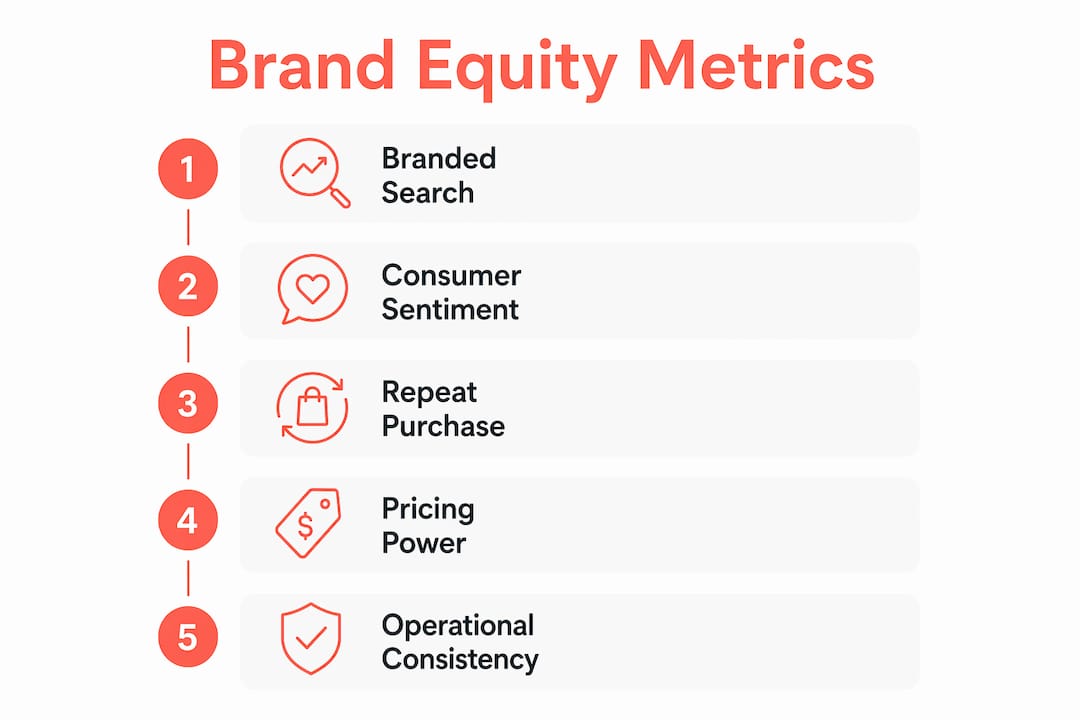
Measuring ecommerce brand equity requires combining two distinct categories of data: state metrics that capture what consumers know and feel, and outcome metrics that capture what they do as a result.
| Metric | Category | What it signals |
|---|---|---|
| Branded search volume | State | Awareness and unprompted recall |
| Net Promoter Score (NPS) | State | Advocacy intent and emotional resonance |
| Sentiment analysis | State | Quality of brand associations and imagery |
| Repeat purchase rate | Outcome | Loyalty and resonance in action |
| Customer lifetime value (CLV) | Outcome | Financial compounding of brand preference |
| Pricing premium achieved | Outcome | Willingness to pay above category average |
The challenge is that single-funnel attribution misses the long-term equity indicators entirely. A brand that measures only first-purchase conversion will optimise for acquisition cost while unknowingly degrading the repeat purchase rate and CLV that make the business profitable over time.
BCG’s First-Fast Response (FFR) methodology addresses this by linking consumer associations directly to sales outcomes, giving brand managers a tighter read on ROI from brand investment. The principle is causal inference: rather than assuming correlation between brand spend and sales, FFR isolates the specific associations driving purchase decisions. This kind of measurement discipline is what separates brands that scale from those that plateau.
Pro Tip: Triangulate your brand equity data across at least three sources: survey-based sentiment, behavioural analytics from your ecommerce platform, and third-party search trend data. Any single source will give you a partial picture and potentially a misleading one.
What are the biggest risks to ecommerce brand equity?
Brand equity erodes quietly before it collapses visibly. By the time declining NPS or rising acquisition costs become obvious, the underlying damage is already months old. Recognising the risk patterns early is the difference between a correction and a recovery.
The most common pitfalls in ecommerce brand equity management include:
- Inconsistent post-click experience: BCG research identifies this as a leading cause of equity failure. Strong top-of-funnel awareness means nothing if the product page is poorly written, the delivery is late, or the returns process is frustrating. Post-purchase inconsistency breaks the trust loop that equity depends on.
- Offer drift in marketplaces: When pricing, advertising, and content changes happen independently across channels without governance, the brand experience fragments. Customers encounter different price points, inconsistent messaging, and conflicting product descriptions. This is what Pattern’s Pi AI engine was specifically designed to prevent.
- Cutting brand investment during downturns: BCG data shows that cutting brand spend costs nearly double to recover. Every dollar removed from brand investment today requires $1.92 in future spend to regain the lost market share. This makes brand equity one of the highest-risk assets to underfund.
- Over-reliance on short-term promotions: Discounts and promotional spikes generate revenue but do not build durable preference. NielsenIQ notes that brands which lead with activation before building equity pay a structural efficiency penalty on every campaign they run.
- Neglecting operational governance: Brand equity is not just a marketing function. It requires cross-functional discipline across product, logistics, customer service, and technology to deliver the consistent experience that builds resonance.
The ecommerce brand reputation you build through operational consistency is far harder for competitors to copy than any campaign or creative execution. That is precisely what makes it valuable.
Key takeaways
Ecommerce brand equity works because it compounds consumer trust, loyalty, and pricing power into a measurable financial asset that makes every marketing activity more efficient over time.
| Point | Details |
|---|---|
| Equity precedes activation | Build brand strength before running campaigns or your acquisition costs will remain structurally high. |
| Trust is quantifiable | BCG’s FFR metric links brand trust directly to an 8-point sales lift and measurable shareholder value. |
| Measurement needs triangulation | Combine branded search, NPS, repeat purchase rate, and CLV to avoid blind spots in equity tracking. |
| Cutting investment is expensive | Removing $1 from brand spend requires $1.92 to recover lost market share, per BCG research. |
| Operational consistency is equity | Post-click experience across delivery, returns, and communications is as important as top-of-funnel creative. |
Brand equity is a long game, and most brands are playing the wrong one
I have worked with enough ecommerce brands to recognise a pattern that rarely gets discussed openly. Most teams understand brand equity conceptually but manage their business as if activation is the whole job. They measure weekly revenue, optimise for conversion rate, and treat brand investment as discretionary spend that gets cut when targets are tight. Then they wonder why their customer acquisition cost keeps climbing.
The uncomfortable truth is that brand equity is the multiplier on everything else you do. When I see a brand with a strong NPS, high repeat purchase rate, and growing branded search volume, I know their paid media is working harder, their email list converts better, and their product launches land with less friction. None of that shows up in a single campaign report. It shows up in the compounding of results over 12 to 24 months.
What I find most underappreciated is the operational dimension. Marketers focus on creative and messaging, but the brands that build genuine resonance are the ones that obsess over the post-purchase experience with the same rigour they apply to their ad creative. A delayed delivery or a clunky returns process undoes months of brand-building in a single interaction.
My advice to brand managers is to treat your equity metrics with the same seriousness as your revenue metrics. Track them monthly. Report them to leadership. And when the pressure comes to cut brand spend, show the BCG data on recovery costs. That conversation changes quickly.
— Liza
How Moormarketing helps you build and activate brand equity
Moormarketing works with ecommerce brands that are serious about building the kind of brand equity that compounds over time, not just campaigns that spike and fade. The team brings senior strategist expertise to every engagement, with proven frameworks that have delivered $3 million a month for a global furniture brand and launched a toy retailer to $2 million in monthly sales.
If you want to understand how your brand equity is performing and where the gaps are, Moormarketing’s ecommerce marketing workshops give your team the tools to measure, build, and activate brand value with precision. For brands ready to scale, the ecommerce growth strategy programme combines brand positioning with activation systems designed for durable revenue growth. The work is hands-on, data-driven, and built around your specific obstacles.
FAQ
What is ecommerce brand equity?
Ecommerce brand equity is the added value a brand name carries in consumers’ minds, built through recognition, trust, emotional associations, and loyalty. It is captured by Keller’s CBBE pyramid across five dimensions: salience, performance, imagery, judgements, and resonance.
How does brand equity affect sales in ecommerce?
Strong brand equity makes activation campaigns more efficient by reducing acquisition costs and increasing repeat purchase rates. BCG research shows that trust, a core component of brand equity, lifts sales by 8 percentage points when present and measurable.
How do you measure brand equity online?
Measuring brand equity online requires combining state metrics such as branded search volume, NPS, and sentiment analysis with outcome metrics including repeat purchase rate, CLV, and pricing premium achieved. Relying on a single data source creates blind spots.
Why is brand equity important for ecommerce brands?
Brand equity creates pricing power, reduces reliance on discounting, and lowers customer acquisition costs over time. BCG data confirms that cutting brand investment costs nearly double to recover, making it one of the highest-risk assets to underfund.
What is the difference between brand equity and brand activation?
Brand equity is the reservoir of consumer trust and preference built over time. Brand activation converts that equity into immediate sales through product, price, and distribution decisions. Without equity, activation is inefficient. Without activation, equity does not generate revenue.