
A digital sales funnel is a visual map of the customer journey from first discovering your brand through to making a purchase. It gives businesses a structured way to track, nurture, and convert leads at every step. Without one, you are guessing at why visitors leave without buying. With one, you have a clear picture of where prospects drop off and exactly what to fix. For entrepreneurs trying to grow online revenue, understanding this concept is the foundation everything else is built on.
What is a digital sales funnel and why does it matter?
A digital sales funnel visually represents the customer journey from awareness through to purchase and beyond, narrowing as prospects drop off at each stage. Think of it as an operating system for your revenue. It gives you structure, visibility, and the data you need to make decisions rather than assumptions.
The importance of a digital sales funnel goes beyond tracking clicks. It tells you which marketing activities are working, which are wasting budget, and where your messaging is failing to connect. A funnel without that visibility is just a wish list.
For eCommerce entrepreneurs, the stakes are high. You might be driving solid traffic but converting very little of it. A well-built funnel shows you exactly where visitors hesitate or drop off, so you can focus your energy on the right problems instead of rebuilding everything from scratch.

Pro Tip: Map your existing customer journey before building a funnel. Interview three to five recent buyers and ask how they found you, what made them hesitate, and what finally pushed them to purchase. Their answers will shape every stage of your funnel.
What are the main sales funnel stages?
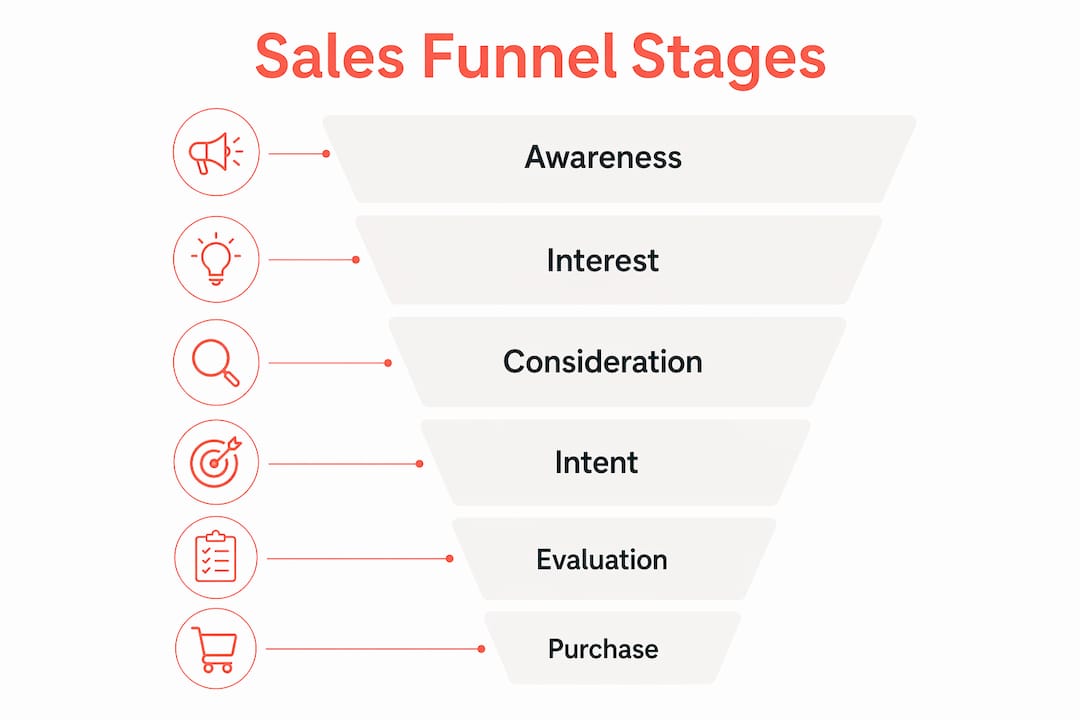
Six key stages define most digital sales funnels: awareness, interest, consideration, intent, evaluation, and purchase. Each stage involves different customer behaviours and different marketing tactics to move prospects forward.
-
Awareness. The prospect discovers your brand for the first time. This happens through paid ads, organic search, social media, or word of mouth. Your job here is to make a strong first impression and give them a reason to stay.
-
Interest. The prospect starts engaging with your content. They read blog posts, watch videos, or follow your social accounts. Your job is to deliver genuine value so they keep coming back.
-
Consideration. The prospect is actively comparing options. They are reading reviews, checking your pricing page, and weighing you against alternatives. Email sequences, case studies, and product demos work well here.
-
Intent. The prospect signals they are ready to buy. They add a product to their cart, request a quote, or sign up for a free trial. This is where retargeting and personalised offers become powerful. A solid eCommerce retargeting strategy can recover a significant portion of these near-buyers.
-
Evaluation. The prospect takes one last look before committing. Strong guarantees, clear return policies, and social proof close the gap between hesitation and purchase.
-
Purchase. The prospect becomes a customer. The funnel does not end here. Post-purchase emails, loyalty programmes, and upsells turn a one-time buyer into a repeat customer.
The funnel narrows at every stage because not every prospect moves forward. That is normal. The goal is not to convert everyone. It is to convert the right people efficiently.
Sales funnel vs sales pipeline vs marketing funnel: what is the difference?
These three terms get used interchangeably, but they describe different things. Confusing them leads to misaligned teams and wasted effort.
The sales funnel focuses on the buyer’s journey, while the sales pipeline focuses on the seller’s internal process for closing deals. A funnel is about what the customer experiences. A pipeline is about what your sales team does next.
A marketing funnel sits upstream from the sales funnel. It covers the awareness and interest stages, where marketing generates and qualifies leads before handing them to sales. In many small businesses, the marketing funnel and sales funnel overlap significantly because one person or team manages both.
| Concept | Focus | Owner | Primary Goal |
|---|---|---|---|
| Digital sales funnel | Buyer’s journey from awareness to purchase | Marketing and sales | Convert prospects into customers |
| Sales pipeline | Seller’s steps to close a deal | Sales team | Move deals through to close |
| Marketing funnel | Lead generation and qualification | Marketing team | Deliver qualified leads to sales |
Understanding these distinctions matters because it determines how you measure success. A sales funnel is measured by conversion rates at each stage. A sales pipeline is measured by deal velocity and close rates. Treating them as the same thing produces metrics that mean nothing.
How do modern digital funnels work in 2026?
The biggest shift in 2026 is moving away from linear funnels toward an interconnected ecosystem of digital touchpoints that support more flexible user journeys. Prospects no longer move neatly from stage one to stage six. They skip stages, revisit content, and convert through paths you did not design.
Modern funnels are built around several core principles:
- Automation with conditional logic. Rather than sending every lead the same email sequence on the same schedule, modern funnels trigger messages based on actual behaviour. A prospect who views a pricing page three times gets a different message than one who only read a blog post. Automation with conditional logic keeps interactions timely and relevant.
- Omnichannel lead capture. Prospects enter your funnel from Google search, Instagram ads, TikTok, email, and direct referrals. Each channel needs its own entry point and nurture path. A strong digital ad campaign feeds multiple funnel entry points simultaneously.
- Real-time performance data. Static monthly reports are not enough. You need live dashboards that show you where prospects are stalling right now, not three weeks ago.
- Non-linear customer paths. Users often skip stages, revisit content, and convert through diverse paths rather than a single funnel flow. Your funnel needs to accommodate that reality, not fight it.
Platforms like monday.com CRM, HubSpot, and Klaviyo all support conditional automation and multi-channel tracking. The tool matters less than the logic you build into it.
Pro Tip: The most common funnel mistake is building it once and walking away. Set a monthly review date to check drop-off rates at each stage. One small fix, like a better subject line or a clearer call to action, can lift conversions across the entire funnel.
How to create a sales funnel for your business
Building a functional digital sales funnel in 2026 requires five clear steps. Each one builds on the last.
-
Define your customer personas. A funnel built for everyone converts no one. Identify your two or three core buyer types. Document their goals, objections, preferred channels, and buying triggers. A furniture eCommerce brand, for example, might have a first-home buyer persona and a property developer persona. Each needs a different funnel path.
-
Capture leads across multiple channels. Use landing pages, lead magnets, social ads, and organic content to pull prospects into your funnel from every relevant platform. TikTok ads, for instance, can be a powerful top-of-funnel channel for product-based businesses. A well-structured TikTok ads strategy feeds awareness at scale.
-
Automate lead qualification. Not every lead is ready to buy. Set up automation criteria that score and segment leads based on behaviour, such as pages visited, emails opened, and time on site. This stops your sales team from chasing cold leads while warm ones go uncontacted.
-
Design nurture sequences for each stage. Write email sequences, retargeting ads, and content that speaks directly to where the prospect is in their journey. A prospect in the consideration stage needs comparison content and social proof. A prospect in the evaluation stage needs a risk-free offer or a strong guarantee.
-
Track, test, and adjust. Companies that align sales and marketing funnels report 36% higher customer retention rates. That alignment starts with shared metrics. Track conversion rates at every stage, identify the weakest point, and test one change at a time. Changing everything at once makes it impossible to know what worked.
The key metric to watch at each stage is the conversion rate from one stage to the next. If 1,000 people reach your product page but only 20 add to cart, that is a 2% conversion rate. Industry context matters, but any rate you can improve directly increases revenue without spending more on traffic.
Key takeaways
A digital sales funnel is the most direct tool an entrepreneur has for turning website traffic into paying customers through a structured, measurable process.
| Point | Details |
|---|---|
| Define the funnel clearly | A digital sales funnel maps the buyer journey from awareness to purchase across six distinct stages. |
| Distinguish related concepts | A sales funnel tracks buyer behaviour; a sales pipeline tracks seller actions; a marketing funnel generates qualified leads. |
| Build for non-linear journeys | Modern prospects skip stages and revisit content, so funnels must support flexible, omnichannel paths. |
| Automate with behaviour triggers | Conditional logic automation delivers the right message at the right time, improving conversion rates. |
| Align and measure consistently | Teams that align marketing and sales funnels see measurably higher customer retention and revenue outcomes. |
Why most funnels fail (and what I have learned from fixing them)
The funnels I see fail most often are not badly designed. They are abandoned. A business owner spends weeks building a funnel, launches it, and then treats it as finished. Six months later, conversion rates have quietly dropped and nobody noticed because nobody was looking.
Viewing the funnel as a static model causes failure. Customer behaviour changes. Competitors change their offers. Platforms change their algorithms. A funnel that worked brilliantly in january can be underperforming by july if you have not adjusted it.
The other mistake I see constantly is expecting a single, clean path through the funnel. Real buyers are messy. They read your blog, forget about you for two weeks, see a retargeting ad, visit your site again, and then buy after reading a review on a third-party site. Your funnel needs to account for that. If you are only tracking direct conversions, you are misreading your own data.
The businesses I have seen grow fastest treat their funnel as a living part of their operation, not a marketing project. They review it monthly, test one element at a time, and connect it directly to their revenue targets. That discipline is what separates a funnel that generates consistent sales from one that just looks good in a presentation.
— Liza
Build a funnel that actually converts with Moormarketing
Understanding the theory is one thing. Building a funnel that generates consistent revenue for your specific business is another challenge entirely.
Moormarketing’s eCommerce marketing workshops are designed specifically for online business owners who want to move from theory to results. Each workshop covers practical funnel building, automation setup, and conversion optimisation, led by senior strategists who work hands-on with your business. Moormarketing has helped clients achieve outcomes like $3 million a month for a global furniture brand and a $2 million monthly sales result for a new toy retailer. If you are ready to build a funnel that works, explore how Moormarketing works with clients and find the right starting point for your business.
FAQ
What is a digital sales funnel in simple terms?
A digital sales funnel is a step-by-step map of the journey a prospect takes from first hearing about your business to making a purchase. It helps you track where leads come from, where they drop off, and what moves them toward buying.
How many stages does a digital sales funnel have?
Most digital sales funnels have six stages: awareness, interest, consideration, intent, evaluation, and purchase. Each stage requires different marketing tactics to move prospects forward.
How does a sales funnel differ from a sales pipeline?
A sales funnel tracks the buyer’s journey and experience, while a sales pipeline tracks the seller’s internal steps for closing a deal. Both are useful, but they measure different things and serve different teams.
How do I know if my funnel is working?
Track the conversion rate between each stage of your funnel. A sales funnel shows exactly where visitors drop off, so you can identify the weakest point and test improvements there first.
How often should I update my digital sales funnel?
Review your funnel at least once a month. Customer behaviour, platform algorithms, and competitor offers all change, and a funnel that is not regularly adjusted will quietly lose performance over time.