

Ecommerce business valuation is the process of calculating what a buyer would pay for your online store, based on profit, growth, and risk. The two core measures are Seller’s Discretionary Earnings (SDE) for businesses under $5M revenue, and EBITDA for larger operations. The multiple applied to those earnings determines your final sale price, and that multiple is where the real money is made or lost. Owners who understand how to increase ecommerce business valuation before going to market consistently achieve better exits than those who focus solely on top-line revenue.
What are the key ecommerce business valuation factors?
Small ecommerce businesses under $5M typically receive SDE multiples between 2.5x and 4.0x. Businesses over $10M with management teams in place command EBITDA multiples from 4.0x to 10.0x. That gap exists because buyers price risk, not just profit.
Several factors drive where your multiple lands:
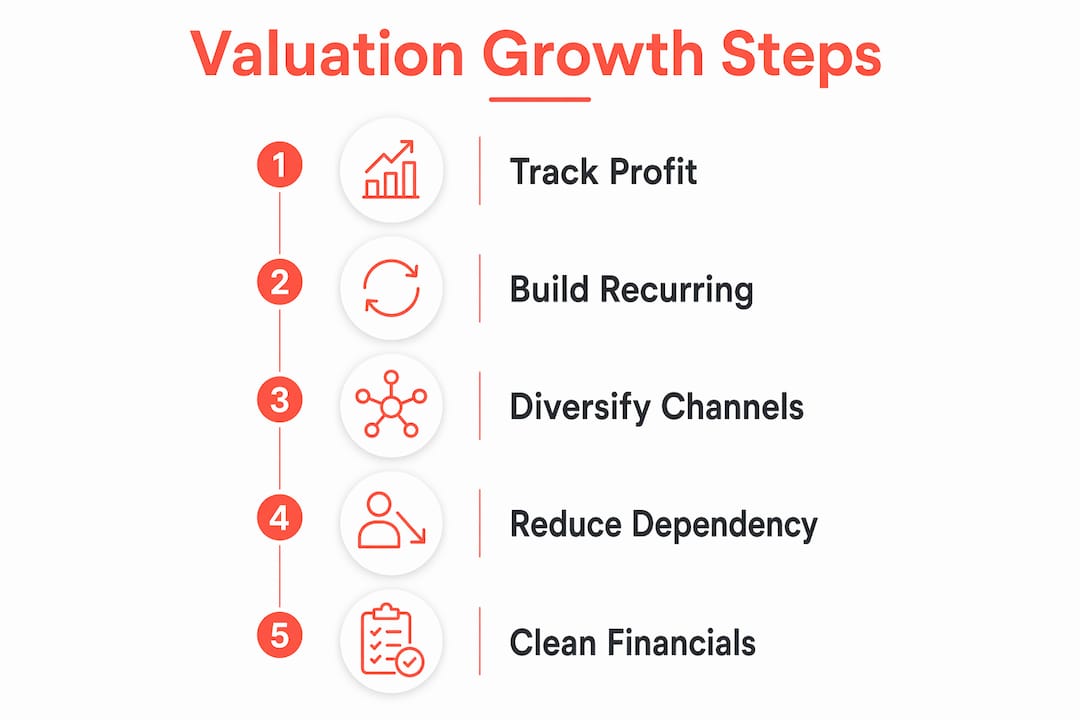
- Profit quality: Buyers scrutinise whether earnings are repeatable and growing, not just present.
- Growth rate: A brand growing at 40% year on year with a 20% EBITDA margin achieves 8x to 10x, compared to 5x for flat growth. Buyers price next year’s potential more heavily than last year’s results.
- Gross margin: Healthy gross margins above 55% sustain valuation. A slide from 55% to 48% can cost 1 to 2 valuation turns.
- Channel concentration: Revenue too dependent on a single platform signals fragility.
- Owner dependency: A business that cannot run without the founder is harder to sell.
- Recurring revenue: Subscriptions and repeat customers reduce acquisition costs and lift multiples.
Pro Tip: Start tracking your SDE or EBITDA at least 24 months before you plan to sell. Buyers want to see a trend, not a single good year.
Buyers pay premiums for predictable, growing revenue engines driven by brand loyalty rather than fragile paid social campaigns. The ecommerce business valuation factors that matter most are the ones that signal durability.

How can you add recurring revenue and increase customer lifetime value?
Recurring revenue is the single most powerful lever for lifting your valuation multiple. Brands with 40–60% recurring revenue from subscriptions command 4x to 10x ARR multiples, far above standard profit multiples. Shifting just 20–30% of revenue to a subscription model adds 0.5x to 1.0x to your multiple.
Here is how to build that recurring base:
- Introduce a subscription or refill model. Physical consumables like supplements, skincare, and pet food convert well. Offer a 10–15% discount for subscribers to drive sign-ups.
- Build an email automation sequence. A post-purchase flow that triggers at the natural repurchase window pulls customers back without paid spend. This directly improves your repeat purchase rate.
- Launch a membership programme. Exclusive pricing, early access, or free shipping for members creates a habit loop that increases purchase frequency.
- Target a repeat purchase rate above 30%. Buyers see this as proof that customers choose you, not just find you.
- Monitor your LTV:CAC ratio. An LTV:CAC ratio above 3:1 signals a healthy, scalable brand. Below 2:1 is a red flag that compresses valuation.
Pro Tip: Email and SMS automation are the cheapest ways to lift repeat purchase rate. Set up a 3-part win-back sequence for customers who have not purchased in 90 days. The revenue it generates costs almost nothing.
Subscribers and repeat customers underpin scalability and reduce reliance on costly acquisition. That is exactly what buyers want to see when they assess your ecommerce growth strategy.
Why is channel and customer diversification crucial for valuation?
Concentration risk is one of the fastest ways to lose multiple points. Channel or customer concentration above 25–30% cuts valuation multiples by 0.5x to 1.5x. A buyer who sees 70% of your revenue coming from a single marketplace knows one algorithm change can destroy the business.
Diversification across DTC, Amazon, wholesale, and retail offers a 15–25% valuation premium. The table below shows how channel mix affects perceived risk:
| Revenue channel | Concentration risk | Valuation impact |
|---|---|---|
| Single marketplace only | Very high | Multiple discount of 0.5x to 1.5x |
| Marketplace plus DTC website | Moderate | Neutral to slight premium |
| Marketplace, DTC, and wholesale | Low | Premium of 15–25% |
| Full omnichannel presence | Very low | Maximum multiple achieved |
Steps to broaden your channel mix before exit:
- Launch a DTC website if you are currently marketplace-only. Own your customer data.
- Test wholesale or retail partnerships to prove the brand works off-platform.
- Build organic search traffic. Shifting 10% from paid to organic can add 0.2x to 0.5x to your multiple. Organic traffic signals a durable asset with low marginal cost.
- Reduce any single customer from representing more than 25% of revenue.
Reducing platform risk and diversifying revenue channels can increase valuation multiples by 0.5x to 1.5x. That is not a marginal improvement. On a $2M SDE business, it is worth $1M to $3M at exit. Understanding how ecommerce businesses are acquired makes this point even clearer.
How to reduce owner dependency and improve operational scalability?
Owner dependency is the most common reason a well-performing ecommerce business sells below its potential. Owner-dependent operations reduce valuation multiples by 0.3x to 0.7x and often force sellers into earn-out arrangements, where part of the sale price is contingent on the founder staying on. That is not a clean exit.
Buyers want a business that runs without you. Here is how to build that:
- Write Standard Operating Procedures (SOPs) for every repeatable task. Customer service scripts, supplier ordering, returns processing, and ad account management all need documented processes.
- Hire or promote a general manager or operations lead. One person who can run day-to-day without you is worth more than any single marketing campaign.
- Automate order management, inventory alerts, and reporting. Manual processes tied to the founder are a liability in due diligence.
- Remove yourself from supplier relationships. Buyers worry that key suppliers will leave with the founder. Introduce your team to suppliers at least 12 months before sale.
Pro Tip: Run a “founder-free week” test. Step away from operations entirely for five business days and document every decision that required you. That list is your SOP backlog.
Valuation hinges on revenue transferability and business resilience, not just raw revenue figures. A business that runs well without its founder is worth materially more than one that does not. Improving operational scalability is not just good management. It is a direct financial strategy.
What financial management practices support higher ecommerce valuations?
Clean financials are the foundation of a credible sale process. Buyers and their advisers will scrutinise your Profit and Loss statement in detail, and any inconsistency creates doubt that compresses the multiple.
A normalised P&L adds back the owner’s salary and removes one-time expenses to show true earnings potential. Buyers need 12–24 months of normalised financials before they will commit to a premium multiple. Start this process well before you intend to sell.
Four financial practices that directly support a higher valuation:
- Normalise your P&L now. Remove personal expenses, one-off costs, and non-recurring items. Show what the business truly earns under normal operating conditions.
- Protect gross margin above 55%. Review supplier contracts, pricing strategy, and product mix. A pricing strategy review often reveals margin recovery opportunities that owners have overlooked.
- Bring inventory days into the 90–120 day range. Excessive inventory days around 250 tie up cash and reduce valuation. Improving inventory turnover is one of the highest-return actions you can take before a sale.
- Eliminate revenue concentration in your financials. If one product SKU drives more than 40% of revenue, buyers see a single point of failure. Diversify the product mix or build the second and third SKUs before going to market.
Consistent, clean financials over 24 months tell a buyer that your business is well-managed and the earnings are real. That confidence translates directly into a higher multiple.
Key takeaways
Increasing your ecommerce business valuation requires consistent action across recurring revenue, channel diversification, owner independence, and financial hygiene, starting at least 24 months before exit.
| Point | Details |
|---|---|
| Multiples vary widely | SDE multiples range from 2.5x to 4.0x for small businesses; larger businesses with teams achieve up to 10.0x. |
| Recurring revenue lifts multiples | Shifting 20–30% of revenue to subscriptions adds 0.5x to 1.0x to your valuation multiple. |
| Concentration cuts value | Channel or customer concentration above 25–30% reduces multiples by 0.5x to 1.5x. |
| Owner dependency costs money | Founder-dependent operations reduce multiples by 0.3x to 0.7x and often force earn-out arrangements. |
| Clean financials are non-negotiable | Buyers need 12–24 months of normalised P&L before committing to a premium multiple. |
What I have learned about building a business worth buying
The uncomfortable truth about ecommerce exits
Most ecommerce owners I speak with think about valuation too late. They start preparing six months before they want to sell, then discover their financials are messy, their operations depend entirely on them, and their revenue is 80% from one channel. At that point, the options are limited.
The businesses that achieve the best exits start 18–24 months out. They treat the business as a product being built for a buyer, not just a revenue machine for themselves. That shift in thinking changes every decision, from hiring to channel strategy to how you structure supplier agreements.
The other thing I see consistently is owners who focus on revenue growth but ignore margin. A business doing $5M in revenue at 30% gross margin is worth less than one doing $3M at 60%. Buyers buy earnings and durability, not turnover. If you are spending heavily on paid ads to prop up revenue without building organic traffic or repeat purchase, you are building a fragile asset.
Start with the levers that compound. Recurring revenue, organic traffic, and a team that does not need you. Those three things, done well over two years, will move your multiple more than any short-term revenue push.
— Liza
How Moormarketing helps you build a more valuable ecommerce business
Building a business that commands a premium multiple takes more than good intentions. It takes a clear growth plan, the right channel mix, and marketing that builds brand equity rather than just burning ad spend.

Moormarketing works directly with ecommerce business owners to build the revenue foundations that buyers pay premiums for. From ecommerce growth strategy to hands-on campaign execution, every engagement is run by senior strategists, not outsourced teams. Moormarketing has helped brands reach $2M and $3M in monthly sales by building the kind of scalable, diversified revenue engines that hold their value. If you are preparing for an exit or investment round, the eCommerce Marketing Workshops are a practical starting point for getting your growth strategy aligned with what buyers actually want.
FAQ
What is ecommerce business valuation?
Ecommerce business valuation is the process of calculating what a buyer would pay for an online store, typically expressed as a multiple of SDE or EBITDA. The multiple reflects profit quality, growth rate, revenue diversification, and operational independence.
What multiple can an ecommerce business achieve?
Small ecommerce businesses under $5M revenue typically achieve SDE multiples of 2.5x to 4.0x. Larger businesses with management teams and strong growth can command EBITDA multiples of 4.0x to 10.0x.
How does recurring revenue affect ecommerce valuation?
Brands with 40–60% recurring revenue from subscriptions command significantly higher multiples. Shifting 20–30% of revenue to a subscription model adds 0.5x to 1.0x to the valuation multiple.
Why does channel concentration reduce valuation?
Buyers discount businesses where more than 25–30% of revenue comes from a single channel or customer, because one platform change can destroy that revenue. Diversification across DTC, marketplace, and wholesale can add a 15–25% valuation premium.
How long before a sale should I start preparing my ecommerce business?
Start at least 24 months before your intended sale date. Buyers require 12–24 months of normalised financial records, and operational changes like reducing owner dependency take time to demonstrate credibly.